What I Learned Building Print2Social: Social Automation Is Not Enough for Store Traffic
A founder postmortem on why automated social posting did not turn into meaningful store demand
What I Learned Building Print2Social: Social Automation Is Not Enough for Store Traffic
First published July 10, 2025. Updated December 2025 with the full story and current status of Print2Social.
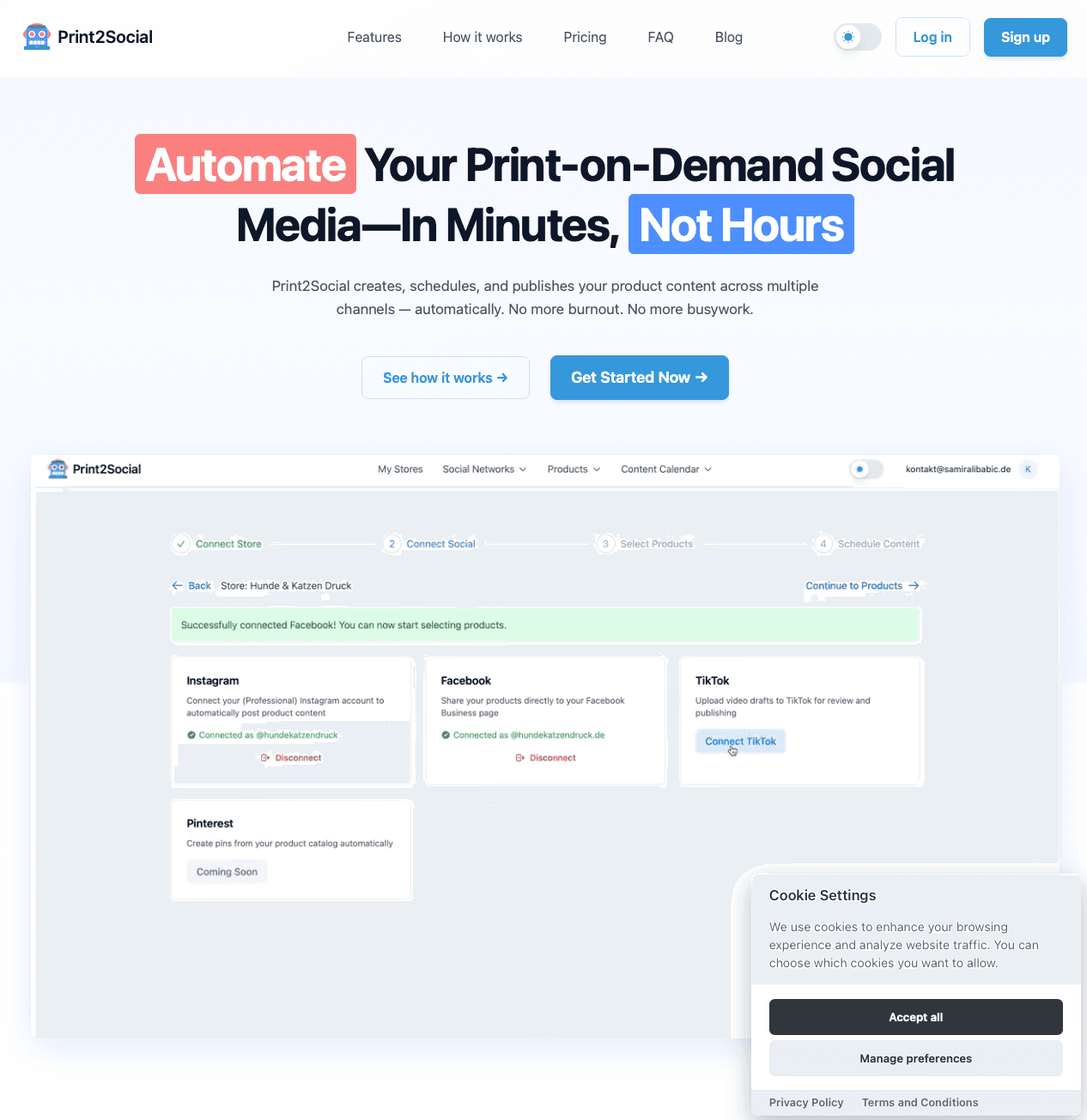
Over the last year I have been building Print2Social, a tool designed to automate social media content for print on demand (POD) and indie e commerce store owners.
The original goal was simple:
- connect your Printful account and your social profiles
- auto generate product content
- keep your feeds active without burning your time
I wanted to help shop owners like myself spend less time on content creation and more time building the business, with the hope that automated posts on Instagram, Facebook, TikTok and later Pinterest would grow our brands and bring real traffic to our stores.
After months of real world testing, a small public launch, and a few more experiments, here is what I learned and where Print2Social stands today.
The reality: social automation brings views, not store traffic
In the first version of Print2Social I connected several of my own stores to Facebook, Instagram and TikTok and let it auto post hundreds of pieces of content.
The tool did what it promised. It created:
- lifestyle images and product highlights for feeds
- short form product clips for TikTok
- regular posts that kept every account “active”
Some TikTok videos reached more than 700 views in the early tests. Later, as I expanded to four stores, one typical 7 day window looked like this across their TikTok accounts:
- roughly 18 000 video views in total
- more than 120 profile visits
- a handful of likes
- 9 new followers
On Meta the picture was even clearer. Across four Facebook Pages and four Instagram accounts, a typical week with more than 100 automated posts produced:
- reach in the low double digits on Facebook
- under one thousand people reached on Instagram
- 0 new followers
- 0 new contacts or messages
Pinterest was the most honest of all. For a while one account showed 26 impressions in a month. The others stayed at zero.
The conclusion is simple:
Social automation can keep your feeds busy, but it does not magically create distribution, followers or sales.
Social media platforms are designed to keep users inside the app. They reward content that drives watch time, replies, saves and shares. Static product content from tiny accounts rarely does that, whether it is posted manually or by a bot.
Even if you gain some views, very few people will click out to your website, and even fewer will buy.
For indie store owners, automated posting alone does not drive targeted, purchase ready traffic.
The first reaction: maybe the posts just need to be shoppable
When I wrote the first version of this article in July 2025, my thinking went like this:
- If people do not like to leave the app, bring the shop to them.
- Meta Shops, TikTok Shop and Pinterest Shopping are built for in app purchases.
- Instead of sending people to external product pages, turn every post into a shoppable surface.
The plan at the time was to pivot Print2Social from “auto posting” to a shoppable social commerce tool.
On paper that meant:
- syncing product catalogs from Shopify, WooCommerce, Printful, Printify
- auto generating media with correct product tags
- publishing to Meta Shops, TikTok Shop and Pinterest Shopping
- so that a customer could buy without ever leaving the app
This direction still makes sense in theory. It is a real problem for many brands.
In practice I did not fully execute that pivot.
Before committing to a big new roadmap, I decided to run one more experiment.
The 14 day experiment: mini launch and more data
I set up a very simple two week test for Print2Social.
On the product side:
- keep four POD stores posting to Facebook, Instagram, TikTok and Pinterest using Print2Social
- only fix critical bugs, no new features, no fancy templates
On the marketing side:
- put a banner for Print2Social on my main site, PrintOnDemandBusiness.com
- send a short email to my list
- cross post about the tool on my social channels
- list it on Product Hunt and resubmit to BetaList
Then I stepped back and looked at the numbers from Google Analytics, Stripe and the social platforms.
What happened on the site and in Stripe
Over the 14 day window and surrounding weeks:
- Google Analytics showed only a few dozen unique visitors to Print2Social
- there was no noticeable spike around the launch date
- sources were a mix of direct, Google, a couple of referrals and a bit from my own sites
Stripe told a similar story:
- monthly recurring revenue hovered around a single digit euro amount
- net volume was low double digits
- the only paying users were a couple of early adopters from before this experiment
- no new customers appeared from the launch channels
As a standalone SaaS, Print2Social did not find traction.
What happened on the stores
On the social side I have already shared the high level numbers.
The short version is:
- hundreds of automated posts per week
- a steady trickle of low intent TikTok views
- almost no new followers or meaningful engagement
- no visible lift in store traffic or sales that I could attribute to the tool
At that point I had enough information to make a decision.
Print2Social today: a useful internal tool, not a product
Print2Social does what it was designed to do.
- It connects to Printful and my social accounts.
- It turns products into posts.
- It saves me time and removes boring manual work.
For that reason I am not shutting it down.
Instead I am changing how I think about it.
- Print2Social now lives on as an internal utility for my own POD test stores.
- I am not actively developing new features for it.
- I am not marketing it, pitching it, or trying to grow it as a SaaS.
- If someone finds it and really wants access, I can still let them in, but it is no longer a focus.
My POD stores themselves are treated as testbeds only. At some point in the future I will likely consolidate everything to a simple Etsy presence or redirect the domains to PrintOnDemandBusiness.com.
The experiment did its job. It answered the question.
What I would tell other founders
I am not writing this to say “never build social tools” or “never start a consumer brand”. Those things can work under the right conditions.
This is what I would highlight after going through this:
1. Do not mistake posts for distribution
It is easy to think that the problem is speed.
“If I could post more often, the algorithm would eventually notice me.”
What I saw in practice is closer to the opposite:
- more product posts from tiny accounts mostly produced more quiet
- even thousands of current TikTok views did not turn into traffic
If the base content format does not give the platform a reason to push you, automating that format just makes you invisible slightly faster.
2. Automation is best used on top of working levers
Print2Social optimised something that was never the main bottleneck.
Saving time is real value, but it is not the same as creating demand.
In hindsight, the more interesting automation problems sit closer to revenue:
- helping people who already have traffic earn more per visitor
- helping people who already close deals close them faster
The next time I build automation for others, I want it to sit under levers that are already proven, not under hope.
3. Demand should be visible before you invest heavily
Print2Social started as an internal tool for my own annoyance.
That part was fine. It is still useful for me.
Where I overreached was treating that initial usefulness as proof that there was a commercial product here.
Before turning future tools into products I want to see:
- clear search demand
- or buyers already paying for a worse alternative
- or a channel where similar products clearly get signups and usage
Internal annoyances are a great source of ideas. They are not enough on their own.
4. Run finite experiments and believe the results
The hardest part is not starting experiments. It is stopping them.
My 14 day launch window for Print2Social was intentionally small. It let me test a few channels, watch the numbers and then make a call.
When the data came back weak, the right move was not “one more feature” or “one more campaign”. It was to accept that the idea, in this form, does not have the pull I hoped for.
That is not a dramatic failure. It is just a closed loop.
Closing
I went into Print2Social hoping that social automation would be an engine for store traffic. What I actually built is a solid little tool that takes boring work off my plate but does not change the fundamentals of distribution.
That is still a win for me personally, and it might become a useful component inside something bigger one day.
For now, the lesson is simple.
Build tools that save you time. Just do not confuse “I can post more” with “more people will care”.
And when the data says a project belongs in the internal toolbox, let it live there and move your focus to where demand is already knocking.